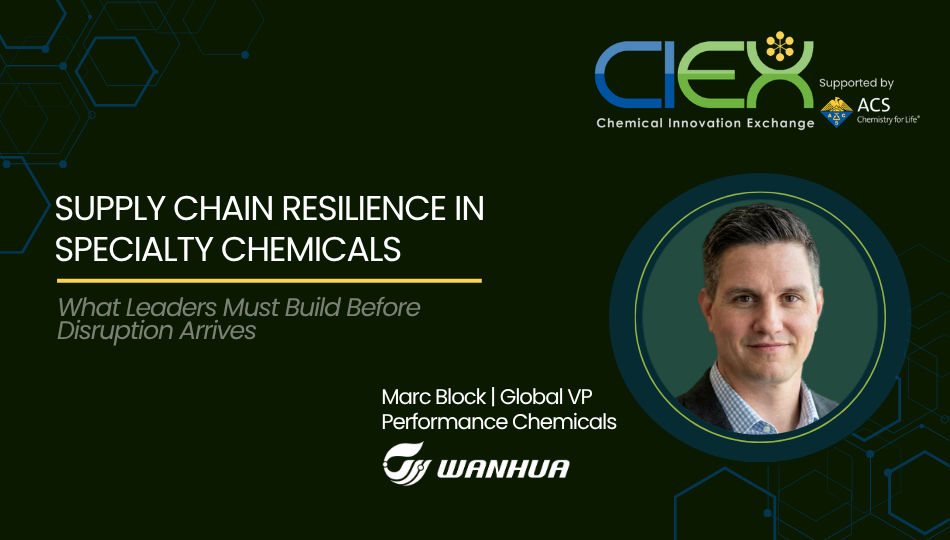

For specialty chemicals companies operating across multiple regions and trade environments, supply chain resilience is no longer an operational consideration — it is a strategic design choice. Ahead of CIEX North America 2026 — September 9–10 in Indianapolis — we sit down with Marc Block, Global VP Performance Chemicals at Wanhua Chemical Group. He brings over two decades of experience building and scaling specialty chemical platforms across Asia, Europe, and North America.
In this interview, he shares how he is approaching the priorities shaping the industry’s next cycle: from building supply chain resilience and repositioning specialty portfolios to evaluating where AI is actually moving business metrics. The conversation also sets the stage for meaningful peer exchange at the event.
CIEX: Without giving too much away – what is the core message of your session and what would you like delegates to remember?
Marc: Supply chain resilience is a design choice that has to be made before disruption arrives. Companies become exposed when their networks are optimized around a single trade-flow assumption, feedstock basis, or asset footprint. The winners will be those that build optionality into chemistry, production, sourcing, and the commercial model, even when that creates some cost and complexity in normal times. The cost of resilience is paid gradually; the cost of fragility arrives all at once when a route closes, a feedstock spikes, or a tariff lands.
CIEX: What motivates you to join CIEX this year – and where are you most looking to learn from peers at this event?
Marc: I have commercial responsibility for a global specialty platform within a Chinese parent company, with assets and activities across Europe, Korea, and North America. That gives me a useful perspective on how the industry is being reshaped by energy costs, China’s cycle, changing trade flows, and tariff uncertainty. At CIEX, I am especially interested in how peers are repositioning specialty portfolios: where they are defending the core, where they are still investing in R&D, and where AI is actually improving business performance rather than just appearing in strategy presentations.
CIEX: How has your approach to balancing volume growth and value creation evolved in recent years – and what’s one decision you’ve made here that would’ve been unthinkable three years ago?
Marc: Three years ago, the default answer in many parts of chemicals was still scale: integrate vertically, run assets hard, and capture share. Our view has become more selective. In recent European portfolio decisions, we have prioritized customer proximity, conversion flexibility, and optionality over scale for its own sake. That would have been harder to justify a few years ago. Today, in a world of tariffs, volatile feedstocks, and regionalized supply chains, flexibility can create more value than pure volume.
CIEX: Where is AI-enabled innovation already moving a hard business metric, and where is it still not delivering?
Marc: The clearest AI impact is in the operational backbone: demand-supply matching, inventory positioning, production optimization, maintenance decision support, and targeted product development. The impact varies by process maturity, but these are areas where the business case is increasingly tangible. Where AI is still less mature is true commercial excellence. Better targeting and lead scoring are useful, but they are not the same as understanding a customer’s application deeply enough to create a better solution. That still depends heavily on human judgment, technical context, and trust.
CIEX: Have we over-optimized for speed at the expense of resilience — or the other way around?
Marc: For a long time, the industry optimized for simplicity and speed. One primary production location, long production runs, narrow sourcing models, and efficient global trade flows were rational choices in a stable environment. The conditions changed. Flexibility now carries a premium: feedstock optionality, conversion redundancy, regional supply capability, and commercial models that can reroute without breaking customer commitments. The lesson is not that speed was wrong. It is that speed and resilience are portfolio choices, and the balance has to be reviewed much more often than before.
CIEX: Looking ahead, what factors and capabilities will define competitive advantage in the chemical industry over the next few years?
Marc: Competitive advantage will come from integrated value-chain control, efficient innovation, commercial excellence at scale, regulatory and trade fluency, capital discipline, and people who can operate across cultures. The companies that win will not be the ones trying to be everywhere. They will be the ones that know where they have the right to win, allocate capital accordingly, and execute faster than the market changes.
Is Your Supply Chain Built to Withstand the Next Disruption?
If your organization is still optimizing around a single feedstock assumption or trade flow, the window to act is narrowing.
At CIEX North America 2026, Marc Block joins senior leaders from SOCMA, Univar, and UPM Adhesive Materials in the panel discussion “Designing for Disruption: How R&D Is Re-Engineering Processes for Feedstock Flexibility and Supply Chain Resilience” to share how leading specialty chemical companies are redesigning chemistry, processes, and supply models for a fragmented world.
This is the conversation. And it is only happening in Indianapolis, September 9–10.
Register for CIEX North America 2026 →