
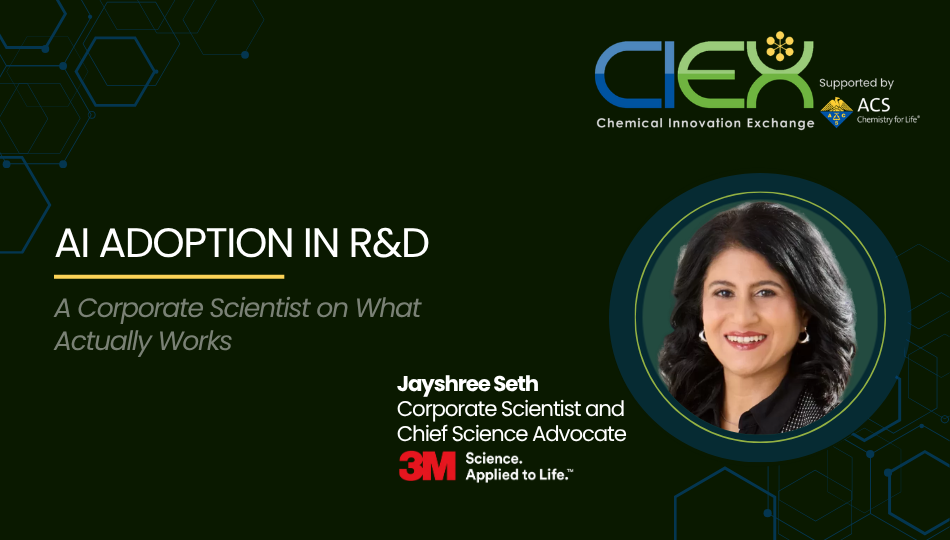
AI adoption in R&D is reshaping how scientific organizations work — but few voices in that conversation come from someone who has spent over 30 years at the bench. Jayshree Seth leads generative AI use cases across 3M’s research organization, holds 80 patents, and brings to CIEX North America 2026 a practitioner’s perspective that is rare in the current AI debate.
Her position is clear: successful AI adoption in R&D does not start with the technology. It starts with something most organizations overlook — and the implications for how R&D teams adopt, scale, and ultimately benefit from generative AI are far more significant than most transformation agendas currently reflect.
CIEX: What is the key message of your session and what should delegates take away for their own R&D organizations?
Jayshree: My key message is simple: don’t start with the technology, start with the pain points – go with the workflow.

Map where the pain is and then let AI address it specifically. What happens when you do this is that people naturally begin reorganizing around AI, not because they were told to, but because they experience its benefits firsthand.
We are seeing that AI fluency within familiar workflows can intuitively spark two things simultaneously – one is meaningful discussions about incremental improvements, and the second is organic conversations about potential AI-first workflow redesign.
The other key takeaway is that driving adoption requires more than mere deployment. Change management is key – communicating benefits with real examples, improving modalities through feedback, and influencing through testimonials from lead users – all backed by visible commitment from leadership. The organizations that do all of this together will not only get adoption but can also build AI fluency as an organizational capability. And that can become a real competitive advantage.
CIEX: What brought you to the conference this year, and what are you most interested in learning from other R&D leaders?
Jayshree: I have been in the Corporate R&D ‘trenches’ for over 30 years, and what brings me to any R&D gathering is curiosity about how others are solving problems we all think about every day. As I lead the effort for use cases of generative AI in R&D, I know that mine is one lens in one organization. Forums like CIEX give us access to a community of practitioners across the chemical and specialty materials industry who are navigating similar transformation – and I look forward to learning and sharing.
Specifically, I’m interested in how organizations are handling the human dimension of this transition. That is a people and culture question as much as it is a technology question. I am also curious regarding measurable impact, where it is emerging and where there are still large gaps between the promise and the reality.
With Generative AI, almost everyone, regardless of expertise or seniority, is like an immigrant navigating genuinely unfamiliar territory. Given that, I believe leaders have a specific role in cultivating each element of the mindset needed: modeling iteration, rewarding experimentation, normalizing change, building navigational judgment, and elevating the voices of those who have crossed the territory the hard way.
CIEX: How has your thinking on AI in R&D evolved, and what is the one shift in how R&D work gets done that would have seemed unlikely three years ago?
Jayshree: As the models and their capabilities have evolved, a fundamental shift in the front end of the innovation process has become possible. This is particularly significant for R&D organizations where literature synthesis, patent landscaping, and competitive intelligence can consume enormous amounts of expert time. I prefer to call AI as I see it – “artificial diligence” – the tireless, unsaturable capacity to process volume that no human can match.
A technical expert can read ten papers before their thinking gets saturated. AI reads a thousand without tiring – and keeps going. It is a diligent partner for our intelligence. So, the shift that would have seemed most unlikely three years ago is this: the bottleneck in R&D is no longer access to information – it’s judgment about what to do with it. It’s no longer about who has the best data, the deepest literature review, the broadest patent landscape.
Generative AI has democratized access to all of that. What it cannot democratize is the wisdom to know which signal matters, which assumption is untested, and which confident-sounding answer is wrong. That wisdom still lives in people. And protecting it, cultivating it rather than assuming AI has replaced it, that is important for R&D leaders.
CIEX: Where is AI already delivering measurable impact in R&D, and where is it still not meeting expectations?
Jayshree: Generative AI is brilliant at breadth – pulling together large bodies of literature, patent landscapes, competitive intelligence, and regulatory frameworks – and presenting a coherent picture and usable taxonomy faster than any team could. That acceleration at the front end of the innovation process is real and can be measured – helping R&D teams move from data to insight faster and with broader context. It can free scientists to spend more time on the work that requires human thinking and judgment and less time on the work that requires human diligence or endurance.
But where AI is brilliant at breadth, it is well known that it can be brittle at precision. In R&D, precision is everything. So, I think there is what I call a “Show Me the Money, Show Me the Source” divide. On the business side, leaders are increasingly using AI-generated insights to demand big outcomes. While technical teams are asking – show me the source. That tension is real, it is growing, and it is where I see the most unmet expectations. This is not a fundamental disagreement – it’s just that the two groups are operating from different professional obligations and standards of evidence, and the gaps need to be bridged.
CIEX: Are we at risk of optimizing R&D for speed at the expense of creativity and long-term innovation?
Jayshree: Yes – it can be a real risk. The pressure to demonstrate AI-driven productivity gains is real, and speed is the easiest thing to measure. But in R&D, the things that are easiest to measure are seldom the most important.
In many ways, it is the classic dilemma of exploration versus exploitation, and generative AI can be an extraordinary exploitation engine. It refines, optimizes, synthesizes, and accelerates faster than we ever could. But breakthrough innovation largely lives in exploration – in that uncommon connection, the failed experiment that reveals something new, the hypothesis that seemed wrong and turned out to be right for a different reason.
My concern is that organizations under pressure to show AI ROI may unconsciously tilt more toward exploitation – the fast, the measurable, the defensible. And so may be the case with competitors. And when everyone optimizes the same way, using the same AI, differentiation disappears.
So, I think it is important to protect the conditions under which creativity happens. Protect time for exploration, such as the 15% culture we have at 3M. And be patient with the non-linear, winding paths that build the kind of wisdom AI cannot replicate.
After all, the most important capabilities are still the ones that have always mattered – balancing creative freedom with business rigor, celebrating intelligent failure alongside successes, and encouraging collaboration and empowerment – these will continue to define competitive advantage even in the age of AI.
Hear Jayshree Seth at CIEX North America 2026
Her session — Gen AI for R&D: Go With the (Work)Flow — addresses how to move generative AI from isolated deployment into workflows that R&D teams actually trust and build on.
September 9–10, 2026 | Indianapolis | Senior leaders from 3M, Dow, Eastman Chemical, Honeywell, Huntsman, Albemarle, Momentive, and Cabot.
What you will leave with:
- Frameworks for mapping AI to high-impact R&D workflows
- Adoption models that build lasting AI fluency across the research organization
- Direct exchange with CTOs, CDOs, and VPs of Innovation
Register for CIEX North America 2026 →