Scaling Chitosan in Chemicals: How Advanced Formulation Is Unlocking Industrial Applications

Despite its well-known properties, chitosan has seen limited adoption in core chemical industry applications.
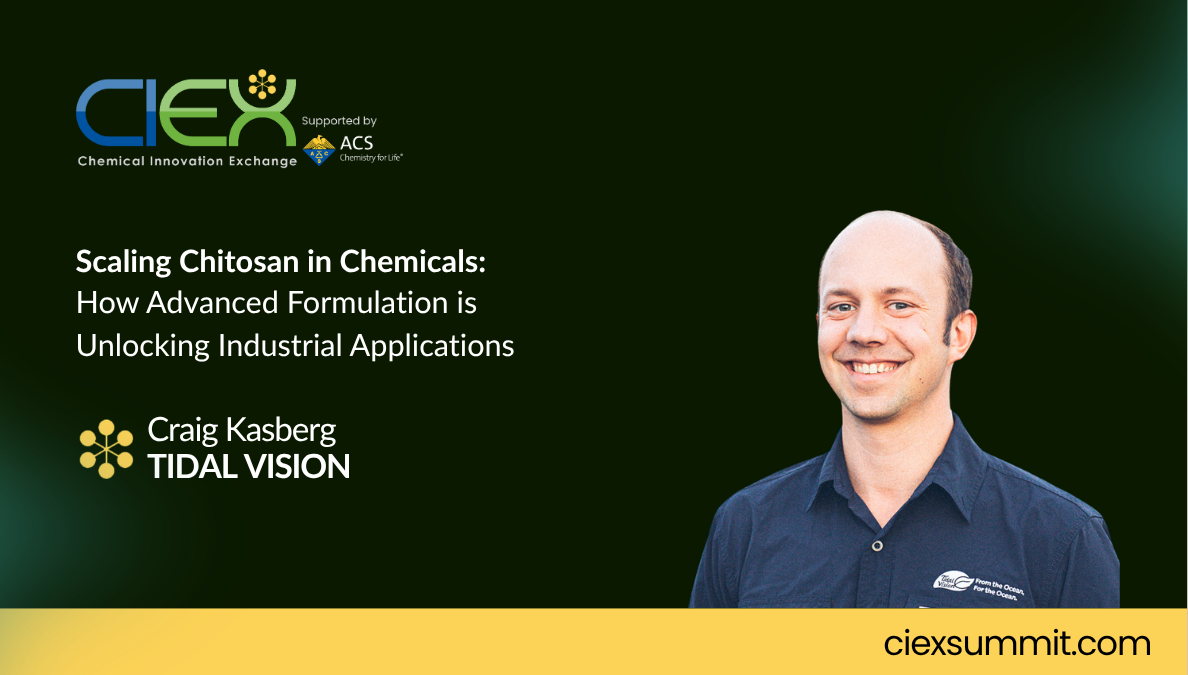
At CIEX North America 2025, Craig Kasberg, CEO of Tidal Vision, outlined how advances in extraction, formulation, and delivery are enabling this widely available biopolymer to move beyond niche use cases and into core chemical industry applications. The discussion highlights how greater control over material properties is translating into more consistent performance—and opening new pathways for integration across established industrial systems.
You can explore the full executive summary from the presentation below.
Moving Beyond the Constraints of Conventional Chitosan
Chitosan’s behavior in industrial systems is highly dependent on how the material is processed and characterized. Variability in molecular weight, composition, and degree of functionalization has made reproducibility a persistent challenge—particularly outside controlled settings.
As noted in Craig’s session:
“Not all chitosan is created equal.”
This challenge is central to the approach presented by Tidal Vision, which focuses on controlling and standardizing the material across its full variability range. While the material itself is not new, the ability to reliably tailor its behavior for specific industrial conditions is what is now enabling broader application.
Functional Properties Driving Industrial Relevance
Chitosan’s relevance stems from a combination of properties that are difficult to replicate in a single material. Its cationic charge allows it to interact effectively with negatively charged particles, particularly in separation and binding processes, while its biodegradability aligns with increasing industry focus on sustainable and circular solutions.
Beyond this, its biological functionality introduces an additional layer of value. As a plant elicitor, it can trigger natural defense and uptake mechanisms, giving it a more active role in biological systems compared to conventional materials.
Within the framework presented, these properties are not viewed in isolation, but as variables that can be engineered and combined depending on the application. Key characteristics include:
- Cationic charge enabling strong particle interaction
- Biodegradability supporting sustainability targets
- Biological activity influencing plant response and uptake
- Flexibility in formulation across different molecular structures
Water Treatment: Efficiency Gains Without System Disruption
One of the most immediate large-scale applications discussed is water treatment, where chitosan is used as a coagulant. In this context, it is being applied in place of traditional inorganic chemistries, particularly aluminum- and iron-based systems.
What stands out is not only the environmental profile, but the operational impact. Lower dosage requirements significantly reduce the volume of chemicals introduced into the system, which in turn decreases sludge generation and associated handling costs. Because chitosan operates at a higher pH compared to conventional coagulants, it also minimizes the need for corrective additives downstream.
These improvements collectively translate into a more efficient treatment process. In certain applications, particularly in food and beverage wastewater, removing inorganic inputs can also improve the quality of byproducts, enabling new options for reuse or upcycling that were previously constrained by contamination from metal-based chemistries.
Agriculture: Enhancing Input Efficiency Through Delivery Mechanisms
In agricultural systems, the application of chitosan is less about substitution and more about enhancement. Its role as both a carrier and a biological trigger allows it to improve how existing inputs—such as fertilizers and crop protection products—are delivered and utilized.
The material’s cationic properties support adhesion to plant surfaces, while its elicitor function activates plant defense and growth responses, which can indirectly improve nutrient utilization. This creates a more efficient pathway for nutrients and active ingredients, increasing the proportion that is absorbed rather than being lost to the surrounding environment.
The session also highlighted advances in formulation, including nano-encapsulation and foliar delivery systems. These approaches make it possible to apply nutrients in ways that were previously less effective, while maintaining compatibility with established agricultural practices. The result is a measurable improvement in input efficiency, achieved without requiring fundamental changes to how growers operate.
Expanding into Material Science Applications
Chitosan’s versatility is further reflected in its growing use across material science applications. Rather than acting as a standalone replacement, it is often introduced as an additive that enhances the performance of existing systems.
Its chemical structure supports improved binding and coating behavior, while its cationic nature contributes to properties such as increased char density in flame-retardant applications. This makes it relevant across a range of industries, from textiles and automotive materials to packaging and specialty coatings.
What is notable in these applications is the flexibility of integration. Because chitosan can be incorporated into existing formulations, allowing manufacturers to improve performance and sustainability profiles without requiring a complete redesign of their products or processes. This incremental approach lowers the barrier to adoption and shortens the path to commercialization.
From Raw Material to Application Platform
A consistent theme throughout the session was that the value of chitosan does not lie in the raw material alone, but in how it is engineered and applied. Achieving reliable performance requires a combination of controlled extraction, precise modification, and advanced formulation, supported by accurate characterization at each stage.
This effectively transforms chitosan from a single material into a broader platform that can be adapted to different industrial requirements. The same underlying biopolymer can behave very differently depending on how it is processed and delivered, enabling it to address a wide range of use cases across sectors.
More broadly, this reflects a shift in how innovation is being approached in the chemical industry. Competitive advantage is increasingly defined not just by the materials themselves, but by the ability to tailor, integrate, and scale them within real-world systems.
Key Takeaways for Industry Leaders
- Chitosan is moving beyond niche applications as advances in formulation and characterization improve consistency at scale
- Its combination of chemical and biological functionality enables both performance enhancement and more efficient delivery of active ingredients
- In water treatment, it offers operational and cost advantages through reduced dosage, lower sludge volumes, and simplified process chemistry
- In agriculture, it improves the effectiveness of existing inputs rather than replacing them, supporting more efficient nutrient use
- In material science, it functions as a flexible additive that can enhance performance without requiring a full system redesign
- Successful deployment depends on integrating material properties with application-specific formulation and delivery systems
Above is an AI- summarized overview of the video presentation shared by Craig Kasberg, CEO, Tidal Vision, at CIEX 2025.
Where These Strategic Questions Move From Theory to Practice
The themes explored here—material performance, formulation control, and the realities of scaling bio-based solutions—are no longer confined to R&D discussions. They are increasingly shaping strategic priorities across the chemical and materials sector.
CIEX North America 2026 is designed as a working forum for senior leaders addressing how emerging materials and technologies move from concept to commercial application. The focus is on the operational and strategic decisions required to scale innovation in real-world environments.
Join senior leaders in R&D, innovation, and sustainability for two focused days tackling:
- Scaling new materials and technologies beyond the pilot phase
- Embedding digital tools and AI into applied R&D workflows
- De-risking innovation through effective collaboration and partnerships
- Translating sustainability priorities into commercially viable solutions
Expect practical case studies, proven approaches, and direct exchange with decision-makers across the chemical industry.
📍 September 9–10, 2026 | Indianapolis, U.S.A.
If you are shaping innovation strategy, R&D direction, or material development pipelines, this is where those conversations move from theory into practice.